
If you're managing a large dairy operation, your teat spray programme runs like clockwork. Twice a day, every day, every cow. Which is exactly why it's worth asking a question most farms never get around to: is the product you're using helping teat condition, or just managing it?
Iodine is an effective broad-spectrum disinfectant with a long track record in New Zealand systems. But it's acidic by nature, and repeated application across a full season can gradually disrupt the natural pH balance of teat skin. Across a herd of 400 cows over six months, that shows up in teat condition score
The pH problem most farms aren't measuring
Healthy teat skin sits at a slightly acidic to neutral pH - roughly 4.5 to 5.5. That range supports the skin's natural barrier function, maintains the keratin plug protecting the teat canal between milkings, and creates an environment hostile to bacterial colonisation.
Iodine-based products applied consistently across a season can push teat skin outside that range, making it drier, more prone to cracking, and paradoxically more vulnerable to bacterial invasion.
Where chlorhexidine works differently
Deosan TEATX with chlorhexidine operates at a pH compatible with the natural environment of teat skin - working within the skin's optimal range rather than against it. Three things follow from that:
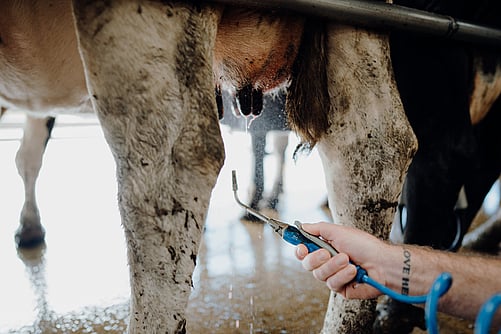
Better teat condition
Farms switching to chlorhexidine typically see improvement in teat end scoring by mid-season; fewer cows with chapping or cracking.
Recovery between milkings
Iodine disinfects. Chlorhexidine disinfects and supports the conditions under which teat skin heals. For cows already showing teat stress, that difference becomes visible within two to three weeks.
Longer residual protection
Chlorhexidine binds to skin proteins and maintains antimicrobial activity after application; the teat retains protection through the period between milkings, not just immediately after dipping.
What this means for your SCC programme
Teat condition is one of the most direct levers influencing SCC. A herd with consistently good teat end scores has fewer points of bacterial entry, lower new infection rates, and more stable counts across the season.
Farms with persistently elevated SCC, high rates of mid-season hyperkeratosis, or teat condition that deteriorates noticeably between August and April are the most likely to see measurable benefit from switching.
Before making any change, score teat ends across at least 20% of the herd and repeat the assessment six weeks after switching. The data will tell you whether the change is working faster than any product claim will.
Talk to your Deosan territory manager
Deosan's territory managers work with operations teams across New Zealand to assess teat health programmes and match the right product to each farm's system. If your SCC is holding but teat condition is telling a different story, it's worth a conversation.