Every dairy operator knows the routine wash. Twice a day, every day, hot detergent and acid move through the plant and the job gets done. But a plant that passes its daily wash can still be quietly building up trouble, and when the grades land, the daily routine on its own often can’t dig you back out. That’s where the bomb wash earns its place.
A bomb wash is the heavy-duty reset: a periodic, high-intensity deep clean designed to strip back the residues that ordinary washing leaves behind. Used at the right moments, it’s one of the most useful tools in the shed for protecting milk quality, machine life and your grade record.
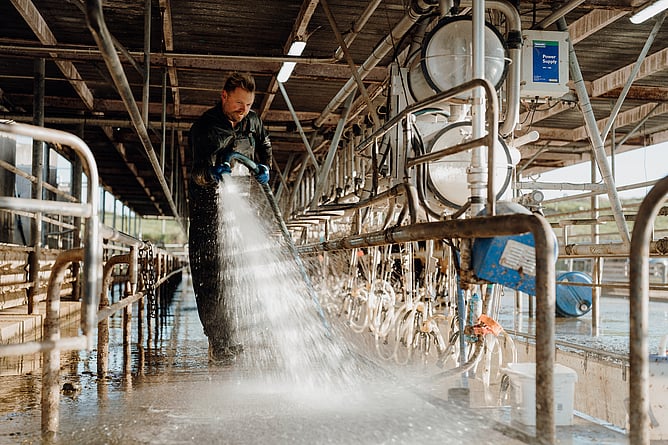
What actually builds up in a “clean” milking plant
No wash system is 100% efficient, and small inefficiencies compound. Over weeks and months, three things quietly accumulate on milk-contact surfaces:
Milkstone. A hard, chalky mineral scale formed when calcium and magnesium from milk and water bond with protein and bake onto surfaces, especially where water is hard or wash temperatures drift. Milkstone is rough and porous, and that texture is the problem: it gives bacteria somewhere to hide.
Fat and protein films. Milk fat and protein that isn’t fully lifted during a wash leaves a thin residue. It’s often invisible, but it’s a food source and a foothold for microbial growth.
Biofilm. Once bacteria colonise those rough, residue-rich surfaces, they can form biofilm - a protective layer that shrugs off a standard wash and continuously reseeds the plant with bacteria between milkings.
The result is a slow creep. The plant looks clean, the daily wash runs as normal, but the bacterial load is climbing beneath the surface until it shows up in the vat.
When to reach for a bomb wash
A bomb wash is both a problem-solver and a preventative tool. Common triggers include:
• Grades on the rise. Climbing Bactoscan, thermoduric or coliform counts are the classic signal that films and biofilm have taken hold. A bomb wash strips the surfaces bacteria are living on.
• Start of season. After the plant has sat over the dry period, a heavy reset clears anything that’s set in and gives you a clean baseline before the first milk goes in the vat.
• Mid-season reset. A scheduled bomb wash partway through lactation keeps buildup from ever reaching the point where it costs you a grade.
• After a wash fault. A failed heater element, a wash pump problem, an air injector that stopped firing, or a run of cool washes can let residue set fast. A bomb wash recovers the ground you lost.
• Hard or variable water. Challenging water accelerates milkstone. Periodic heavy acid work keeps scale in check.
• Visible signs. Cloudy stainless, a film you can feel with a gloved finger, or scale around jetters and the receiver are all telling you it’s time.
If grades have already landed, work systematically, identify the type of grade first, look at what’s changed recently, and compare against your last good result. A bomb wash is a powerful part of the fix, but it works best alongside finding the root cause.
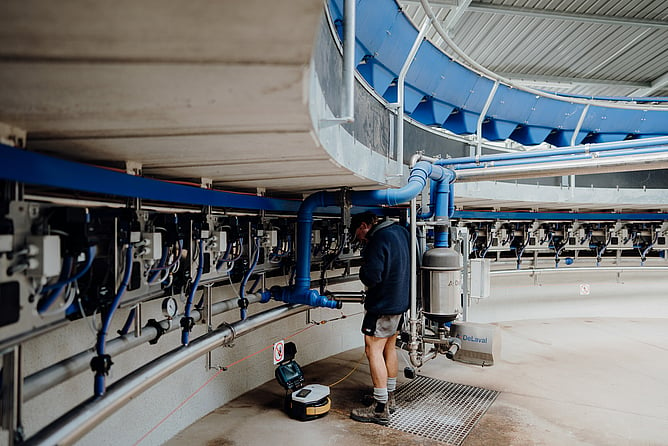
How a dairy plant bomb wash works
The principle is simple: turn up every lever that drives cleaning at once; heat, chemical strength, contact time and mechanical action, to remove what a routine wash leaves behind.
A thorough bomb wash generally means:
1. A strong chlorinated alkaline hot wash to break down and lift baked-on fat and protein. Chlorine helps fracture protein deposits, while the alkali saponifies and removes fat. This is the heart of the wash.
2. A heavy acid wash to dissolve mineral scale and milkstone that alkali can’t touch. On plants with significant scale, this is where the real gains show up.
3. Heat that holds. Cleaning chemistry depends on temperature. Water that’s too cool lets removed soil redeposit; industry guidance is to aim for around 80–85°C leaving the hot water cylinder and to dump the wash before it drops below about 55°C.
4. Full circulation and contact time. The solution needs to reach every surface; milk line, receiver, droppers, jetters and clusters, with enough turbulence (a working air injector/flushing pulsator matters here) and enough time to do its job.
5. Manual attention where it counts. Trouble spots that never quite come clean; certain unions, the long tail bend, the receiver, can be brushed between the alkaline and acid stages. Sometimes the parts that need it most are the ones you can’t see the wash reaching.
How to run a bomb wash safely
A bomb wash uses chemicals at their strongest, so the safety basics matter more than ever:
• Always add chemical to water, never water to chemical.
• Never mix acid and alkaline products together. Run them as separate stages with a rinse between.
• Wear the right PPE: gloves, eye protection and covering, and keep the shed well ventilated, particularly with chlorinated and acid products.
• Follow label rates. Stronger isn’t automatically better, and every product has a correct concentration.
• Protect your gear. Very hot water and aggressive chemistry can damage seals, rubberware and some metals if misused, follow the guidance for your plant and products.
Prevention beats cure
The best bomb wash is the one you didn’t need in a panic. Built into your season as a planned reset - start of season, and again mid-way, it stops buildup before it ever threatens a grade, and it keeps your daily wash working the way it should.
The right programme depends on your water, your plant and your milking system, and getting the chemistry matched to your conditions is what makes the difference between a wash that looks clean and one that is clean.
Frequently asked questions
How often should you do a bomb wash?
As a preventative routine, most operators run one at the start of the season and again mid-lactation. Beyond that, run one whenever grades start climbing, after a wash-system fault, or if you’re on hard water that builds scale quickly.
What’s the difference between a bomb wash and a daily wash?
A daily wash keeps the plant food-grade between milkings. A bomb wash is a periodic, higher-intensity deep clean that turns up heat, chemical strength and contact time to strip back the milkstone, fat films and biofilm that daily washing gradually leaves behind.
Can a bomb wash fix rising Bactoscan or thermoduric grades?
It’s often a big part of the fix, because it removes the surfaces bacteria live on. But it works best alongside finding the root cause — identify the type of grade, check what’s changed recently, and compare against your last good result.
Thats where we come in
The Deosan hygiene range; chlorinated alkaline detergents, heavy-duty acids and the products that go with them, is built for exactly this kind of work: powerful on the grime that daily washing leaves behind, without punishing your plant.
If your grades are creeping, the season’s about to start, or you just want a bomb wash routine that’s dialled in to your farm, talk to your local Deosan Area Manager.
We’ll help you build a wash programme that keeps your shed at the standard it should be: a clean, food-grade factory, every single milking.